Technology, ownership and human sovereignty

Citizens or Subjects?

Read it. Challenge it. Refer it.

What happens when AI and robotics can generate extraordinary abundance while human labor becomes less economically necessary - and the institutions distributing that abundance can also manage the people who depend on it?
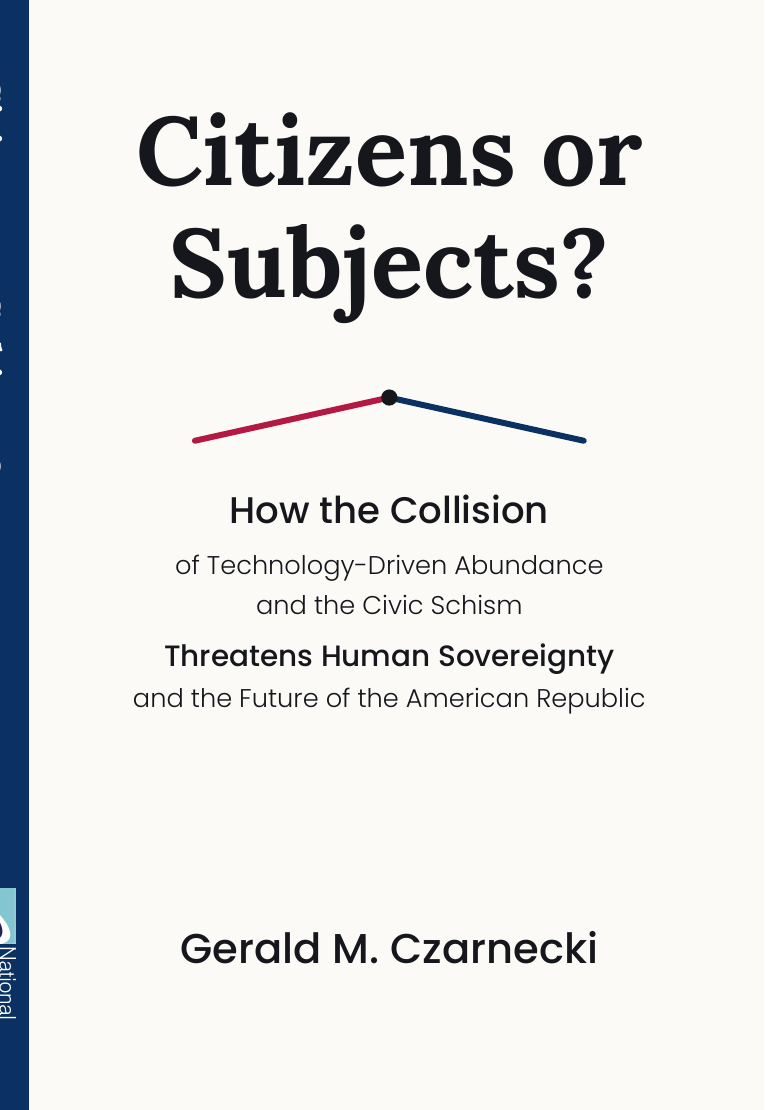
Front cover of Citizens or Subjects? by Gerald M. Czarnecki
The central idea

The danger is the Collision.

Force 1

Technology-Driven Abundance

AI, agentic systems, robotics and advanced computing can increase output while reducing the amount of human labor required to create it.

Force 2

The Civic Schism

A struggle over whether rights belong to citizens prior to institutions - or are increasingly administered, conditioned and managed by institutions.

The Collision

Who governs whom?

When economic leverage weakens at the same time institutional control becomes more technically capable, material abundance does not automatically preserve human sovereignty.

Three ideas to test

Enter the argument through its strongest claims.

A public prediction

The 2030 Wager

The book makes a claim specific enough to lose: AI disruption should become visible first in entry-level hiring for cognitive occupations, not necessarily in headline unemployment.

What would prove the book wrong?

Watch the first rung

Software
Entry-level share of hiring
Junior analysis
Hiring versus output
Paralegal work
New entrants versus total employment
Administrative work
Routine cognitive hiring
The harder economic question

If machines create more of the wealth, who owns the claim?

Income can sustain consumption. Ownership protects independence.

The book calls the unresolved problem Citizen Capital: how to create enforceable ownership for citizens without turning the state into the permanent owner, allocator or gatekeeper.

Explore Citizen Capital
For readers

Do not start by agreeing.

Start by identifying the weakest proposition. The project welcomes informed criticism and evidence that weakens the thesis as well as evidence that strengthens it.

Host a Discussion Table
For media

A book built for argument.

AI and entry-level jobs. Ownership after automation. Agentic judgment. State capitalism. Human agency. An AI-written epilogue. Producer-ready background is available.

Media resources
Beyond the book

National Leadership Institute

The book is published by National Leadership Institute Press. NLI's broader work now joins leadership and governance with liberty, human dignity and human sovereignty.

Visit NLI
Continuing the argument

On Liberty

On Liberty is the planned continuing letter from the National Leadership Institute on liberty and human sovereignty. The book begins the argument; the letter will continue it as events develop.